Does House of Representatives Vote on Supreme Court Nominees
The nomination, confirmation, and appointment of Justices to the Supreme Court of the U.s.a. involves several steps set along past the United States Constitution, which take been farther refined and developed by decades of tradition. Candidates are nominated by the President of the United States and must face a series of hearings in which both the nominee and other witnesses make statements and respond questions before the Senate Judiciary Committee, which can vote to transport the nomination to the total United States Senate.[ane] Confirmation by the Senate allows the President to formally appoint the candidate to the court.[1] The Constitution does not set any qualifications for service equally a Justice, thus the President may nominate any individual to serve on the Courtroom.
Senate cloture rules historically required a two-thirds affirmative vote to advance nominations to a vote; this was changed to a iii-fifths supermajority in 1975. In Nov 2013, the and then-Democratic Senate majority eliminated the filibuster for executive branch nominees and judicial nominees except for Supreme Courtroom nominees, invoking the so-called nuclear option. In April 2017, the Republican Senate majority practical the nuclear selection to Supreme Court nominations also,[2] enabling the nomination of Trump nominee Neil Gorsuch to proceed to a vote.[iii]
Nomination [edit]
Article Ii, Department ii, Clause 2 of the United States Constitution, known as the Appointments Clause, empowers the president to nominate and, with the confirmation (communication and consent) of the United States Senate, to engage public officials, including justices of the Supreme Court. This clause is one case of the organisation of checks and balances inherent in the Constitution. The president has the plenary power to nominate and to engage, while the Senate possesses the plenary power to pass up or confirm the nominee prior to their appointment.[4]

Flowchart showing process of date of United States Supreme Court justices.
Upon the election of a new President, incoming White Business firm staff gear up profiles of possible candidates for the Supreme Court, considering non simply judges just too politicians and other individuals whom they consider appropriate for the part. Besides because national figures whose views are well-known, they consider others who are less recognized. They go through published rulings, manufactures, speeches, and other background material to get an thought of candidates' values and views on constitutional issues. Age, health, race, gender, pedagogy, and likelihood of confirmation are likewise factored into considerations. Once a Supreme Court vacancy opens, the President discusses the candidates with advisors. Senators also call the president with suggestions, though he is not obliged to accept their communication on whom to nominate, neither does the Senate have the authority to gear up qualifications or otherwise limit who the president may select.[four]
After a offset selection is decided, the candidate is contacted and chosen on by the President to serve on the highest court. Staffers ship a vetting class for the candidate to fill up out. They visit the candidate to become over tax records and payments to domestic help. A formal FBI groundwork cheque is conducted. Candidates whom the President has never met are interviewed by White Business firm officials before being sent to the White Business firm to be interviewed in person by the President. After making a final decision, the President calls the candidate, who is told to gear up a argument for an appearance in front end of the national press for the President's formal annunciation. The nominee then meets with senators and prepares for confirmation hearings.
Most Presidents nominate individuals who broadly share their ideological views.[5] In many cases, however, a Justice'southward decisions may be contrary to what the nominating President predictable. A famous instance was Chief Justice Earl Warren; President Dwight D. Eisenhower expected him to be a bourgeois judge, only his decisions are arguably among the about liberal in the Court'due south history. Eisenhower later chosen the engagement "the biggest damn fool error I ever made".[6] Another Justice whose decisions ran opposite to what was believed to be his ideology was David Souter, who was nominated to the high courtroom in 1990 by President George H. W. Bush-league. Many pundits and politicians at the time expected Souter to be a bourgeois; however, after condign a Justice, his opinions mostly savage on the liberal side of the political spectrum.
Confirmation [edit]
In modern times, the confirmation process has attracted considerable public attention. The Senate Judiciary Committee plays a key role in that process, equally each Supreme Court nomination comes before it for review. The commission conducts hearings, examining the background of the nominee, and questioning him or her about their views on a variety of cases and their general judicial philosophy.[7] At the close of confirmation hearings, the committee votes on whether the nomination should get to the total Senate with a positive, negative or neutral report.[8]
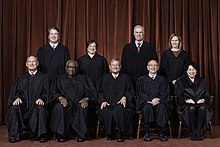
The committee's do of personally interviewing nominees is relatively recent, beginning with Harlan Fiske Rock in 1925. Some western senators were concerned with his links to Wall Street and expressed their opposition when Stone was nominated. Stone proposed what was then the novelty of appearing earlier the Judiciary Committee to answer questions; his testimony helped secure a confirmation vote with very piddling opposition. The 2d nominee to appear before the Judiciary Committee was Felix Frankfurter, who only addressed (at the committee'due south request) what he considered to be slanderous allegations against him.[9] The modern exercise of the commission questioning nominees on their judicial views began with the nomination of John Marshall Harlan Two in 1955; the nomination came presently after the Supreme Court handed downwardly its landmark Dark-brown v. Board of Education decision, and several southern senators attempted to cake Harlan's confirmation, hence the determination to testify.[1] [7]
Once the commission reports out the nomination, it is put before the whole Senate for final consideration. A simple majority vote is required to confirm or to reject a nominee. Historically, such rejections are relatively uncommon. Of the 37 unsuccessful Supreme Court nominations since 1789, but eleven nominees have been rejected in a Senate roll-telephone call vote.[10] The about contempo rejection of a nominee by vote of the full Senate came in October 1987, when the nomination of Robert Bork as an associate justice was rebuffed past a 42–58 vote.[ix] [11]
Prior to 2017, a successful filibuster threat could add the requirement of a supermajority of threescore needed in favor of cloture, which would allow debate to end and forcefulness a final vote on confirmation. Under the old rule, a nominee could be filibustered in one case contend on the nomination had begun in the full Senate. A filibuster indefinitely prolongs the debate, preventing a last vote on the nominee. President Lyndon Johnson'south 1968 nomination of incumbent Associate Justice Abe Fortas to succeed Earl Warren as chief justice, during the terminal year of his presidency, was subject field to a successful filibuster which forced the president to withdraw the nomination.[A] The effort included both Republican and Autonomous senators concerned about Fortas' business ethics. Though prevented from becoming primary justice, Fortas remained on the Court as an associate justice.[12] More than recently, an effort to filibuster President Donald Trump'south nomination of Neil Gorsuch to the seat left vacant by Antonin Scalia's decease was effective, if non successful. Dissimilar the Fortas delay, even so, but Democratic Senators voted against cloture on the Gorsuch nomination, citing his perceived conservative judicial philosophy, and the Republican leadership's prior refusal to have up President Barack Obama's nomination of Merrick Garland to fill the vacancy.[13] [14] The Republican bulk responded by changing the rules to allow for filibusters of Supreme Court nominations to be cleaved with only 51 votes rather than 60. The precedent for this action had been set in November 2013, when the Democrats, who and then held the majority, changed the rules, lowering the threshold for advancing nominations to lower court and executive branch positions from 60 votes to a unproblematic majority, just explicitly excluded Supreme Court nominations from the change.[xv] [16]
In that location are others ways that a nomination tin can exist batty prior to the concluding vote in the Senate. A president has the prerogative to withdraw a nomination at whatever point during the process, typically doing then if it becomes clear that the Senate volition reject the nominee. This occurred nearly recently with the nomination of Harriet Miers in 2006 before Committee hearings had begun, citing concerns about Senate requests during her confirmation process for access to internal Executive Co-operative documents resulting from her position as White House Counsel. In 1987, President Ronald Reagan withdrew the nomination of Douglas H. Ginsburg because of news reports containing marijuana use allegations.
Similarly, the Senate has the prerogative to tabular array a nomination "indefinitely", finer eliminating any prospect of the person's confirmation. Senators have voted to postpone a nomination on only three occasions (Crittenden, Taney, and Male monarch- all in the 19th century). Even then, the Senate tin can achieve the aforementioned upshot without taking vote to postpone.[17] It tin just choose to take no action on a nomination, which expires at the end of the session. For example, President Dwight Eisenhower's first nomination of John Marshall Harlan Two in November 1954 was non acted on by the Senate; Eisenhower re-nominated Harlan in January 1955, and Harlan was confirmed two months later on. Most recently, the Senate refused to consider President Barack Obama'due south March 2022 nomination of Merrick Garland; the nomination expired in January 2017, and the vacancy was afterwards filled by President Donald Trump'south appointment of Neil Gorsuch.[xviii]
Before 1981 the approval process of Justices was unremarkably rapid. From the Truman through Nixon administrations, Justices were typically approved within one month. From the Reagan administration to the nowadays, however, the process has taken much longer. According to the Congressional Enquiry Service, the average number of days from nomination to final Senate vote since 1975 is 67 days (2.2 months), while the median is 71 days (or 2.3 months).[nineteen] [20] Some believe this is because Congress sees Justices every bit playing a more political function than in the past.[21] The perceived politicization of the process has drawn criticism. For example, columnist George F. Will termed the defeat of Robert Bork's nomination "unjust" and, more mostly, that the nomination procedure does "not delve securely into the nominee's jurisprudential thinking."[22] Supreme Courtroom nominations have angry much media speculation almost whether the guess leans to the left, heart, or right.[23] I indication of the politicized pick process is how much time each nominee spends existence questioned under the glare of media coverage; before 1925, nominees were never questioned;[24] since 1955, every nominee has been required to appear before the Senate Judiciary Committee and answer questions. Also, the hours spent being grilled have lengthened from unmarried digits before 1980 to double digits today.[25]


Following is a table of the guess number of hours that media sources estimate were spent on the questioning of Supreme Courtroom nominees since 1925:
| Yr | Nominee | # Hours | # Questions[B] |
|---|---|---|---|
| 1925 | Harlan F. Stone | 5 | 0 |
| 1938 | Felix Frankfurter | 0 | 0 |
| 1955 | John Marshall Harlan II | 0 | 0 |
| 1957 | William J. Brennan Jr. | 3 | 0 |
| 1967 | Thurgood Marshall | vii | 0 |
| 1968 | Homer Thornberry (West) | 0 | 0 |
| 1971 | William Rehnquist | 7 | 0 |
| 1975 | John Paul Stevens | 6 | 5 |
| 1981 | Sandra Day O'Connor | 12 | 8 |
| 1987 | Robert Bork (NC) | xxx | 15 |
| 1987 | Anthony Kennedy | eleven | 47 |
| 1990 | David Souter | 20 | 4 |
| 1991 | Clarence Thomas | 25 | eighteen |
| 1993 | Ruth Bader Ginsburg | 20 | twenty |
| 1994 | Stephen Breyer | twenty | 5 |
| 2005 | John Roberts (CJ) | 20 | 231 |
| 2005 | Harriet Miers (West) | 0 | 0 |
| 2006 | Samuel Alito [26] | 18 | approx. 700 |
| 2016 | Merrick Garland (NC) | 0 | 0 |
| 2017 | Neil Gorsuch | 20 | 324 |
| 2018 | Brett Kavanaugh | 48 | 1,278 |
| Sources:[7] [9] [25] [27] | |||
Once the Senate confirms the nomination past an affirmative vote, the Secretary of the Senate attests to a resolution of confirmation and transmits it to the president, who then signs a commission officially appointing the nominee to the Courtroom.[28] The date of commission determines a justice's seniority.[29] Afterward, a ceremony is held at which the appointee must take the ramble oath, which is used for every federal and state officeholder below the president, and the judicial oath used for federal judges earlier entering into the execution of their office.[30]
It is at this betoken that a person has taken "the necessary steps toward condign a member of the Court." Through October 2018, 126 nominees accept been confirmed and appointed to the Court. Of these, seven either declined their committee or (in ane example) died earlier assuming role, and are not considered to have served as a Supreme Courtroom justice.[31]
Nominations in the last twelvemonth of a presidency [edit]
Political scientist Michael Nelson wrote in 2012 that the Senate is less likely to corroborate Supreme Court nominations that are submitted during the final year of a presidency.[32] Although Supreme Court vacancies rarely arise during the last year of a presidency,[33] [34] [35] this blazon of situation received considerable public attention in 2022 post-obit the death of Antonin Scalia,[36] [37] and again in 2022 upon the death of Ruth Bader Ginsburg.
Police force professors Jason Mazzone and Robin Kar published a study in 2022 in which they wrote that a detailed analysis of Senate history does not support a deliberate inter-presidential transfer of nominating ability from ane president to the next. In their view, an actual vacancy ought to be viewed differently from a vacancy that is announced in advance but never really vacated ("NV"); an elected president who makes a nomination ought to be viewed differently from a president-by-succession ("Southward"); and, a nomination made postal service-ballot-of-successor ("PE") should exist distinguished from a nomination fabricated earlier.[38] [39]
Following is a list of those people who were nominated to the Supreme Court during the last year of a president's concluding term.[C] This list does not include presidents who never had an opportunity to serve what would have been their last year, due to resignation or death.
| Nominee | Nominated by | Nomination | ||||||
|---|---|---|---|---|---|---|---|---|
| President | Party | Cease date of term | Date submitted | Majority party | Consequence and date | MKC | ||
| John Jay (CJ) | J. Adams | Fed | Mar. 4, 1801 | Dec. 18, 1800 | Fed | Confirmed[D] December. 19, 1800 | PE | |
| John Marshall (CJ) | January. 20, 1801 | Confirmed Jan. 27, 1801 | PE | |||||
| John J. Crittenden | J. Q. Adams | Rep (A-C) [Due east] | Mar. 4, 1829 | December. 17, 1828 | Rep (J-C) [East] | Postponed[F] February. 12, 1829 | PE | |
| John Catron | Jackson | Dem | Mar. iv, 1837 | Mar. 3, 1837 | Dem | Confirmed Mar. eight, 1837 | PE | |
| William Smith | Mar. three, 1837 | Confirmed[D] Mar. 8, 1837 | PE | |||||
| Peter Vivian Daniel | Van Buren | Dem | Mar. four, 1841 | Feb. 26, 1841 | Dem | Confirmed Mar. two, 1841 | PE | |
| Reuben Walworth | Tyler | None | Mar. iv, 1845 | Mar. xiii, 1844 | Whig | Withdrawn June 17, 1844 | S | |
| Edward King | June 5, 1844 | Postponed[F] June 15, 1844 | S | |||||
| John C. Spencer | June 17, 1844 | Withdrawn June 17, 1844 | S | |||||
| Reuben Walworth | June 17, 1844 | No action[G] Jun 17, 1844 | S | |||||
| Reuben Walworth | Dec. four, 1844 | Withdrawn Feb. 6, 1845 | PE; Southward | |||||
| Edward Rex | Dec. 4, 1844 | Withdrawn Feb. 8, 1845 | PE; S | |||||
| Samuel Nelson | Feb. four, 1845 | Confirmed Feb. 14, 1845 | PE; S | |||||
| John Chiliad. Read | Feb. 7, 1845 | No action | PE; S | |||||
| Edward A. Bradford | Fillmore | Whig | Mar. 4, 1853 | Aug. 16, 1852 | Dem | No activity | S | |
| George Due east. Badger | Jan. 3, 1853 | Withdrawn February. 14, 1853 | PE; S | |||||
| William C. Micou | Feb. fourteen, 1853 | No activity | PE; S | |||||
| Jeremiah South. Black | Buchanan | Dem | Mar. 4, 1861 | Feb. 5, 1861 | Dem | No activity[H] Feb 21, 1861 | PE | |
| William Burnham Woods | Hayes | Rep | Mar. iv, 1881 | Dec. 15, 1880 | Dem | Confirmed Dec. 21, 1880 | PE | |
| Stanley Matthews | January. 26, 1881 | No action[I] | PE | |||||
| Melville Fuller (CJ) | Cleveland | Dem | Mar. 4, 1889 | Apr. 30, 1888 | Rep | Confirmed July 20, 1888 | — | |
| George Shiras Jr. | B. Harrison | Rep | Mar. four, 1893 | July 19, 1892 | Rep | Confirmed July 26, 1892 | — | |
| Howell E. Jackson | February. ii, 1893 | Confirmed Feb. xviii, 1893 | PE | |||||
| Abe Fortas (CJ) | L. Johnson | Dem | Jan. 20, 1969 | June 26, 1968 | Dem | Withdrawn[J] Oct. two, 1968 | NV | |
| Homer Thornberry | June 26, 1968 | Withdrawn[K] Oct. 2, 1968 | NV | |||||
| Merrick Garland | Obama | Dem | January. 20, 2017 | Mar. 16, 2016 | Rep | No action | — | |
| Amy Coney Barrett | Trump | Rep | January. xx, 2021 | Sep. 29, 2020 | Rep | Confirmed Oct. 26, 2020 | — | |
| Sources:[38] [41] [42] [43] | ||||||||
Recess appointments [edit]

Article Ii, Section ii of the U.S. Constitution provides that:
The President shall take Power to fill up all Vacancies that may happen during the Recess of the Senate, by granting Commissions which shall expire at the End of their side by side Session.
Thus, when the Senate is in recess, the President may make a temporary engagement to any office requiring Senate blessing, including filling vacancies on the Supreme Courtroom, without the Senate's communication and consent. Such a recess appointee to the Supreme Court holds part only until the terminate of the side by side Senate session (always less than ii years). To continue to serve thereafter and be compensated for his or her service, the nominee must be formally nominated past the president and confirmed by the Senate. Of the 12 justices who take received recess appointments (two as chief justice and 10 as associate justice) simply Chief Justice John Rutledge was not later confirmed for a regular appointment. No president since Dwight Eisenhower has fabricated a recess date to the Supreme Courtroom and the practise has become highly controversial even when practical to lower federal courts. During the 110th Congress, the Democratic leadership of the Senate specifically blocked President George Due west. Bush-league, a Republican, from making whatever recess appointments with the utilise of pro forma sessions.
In 1960 the Senate passed a resolution stating that it was the sense of the Senate that recess appointments to the Supreme Courtroom should non be made except under unusual circumstances.[44] Being a resolution, it has no legally binding effect, but was intended as an expression of the position of the Senate and as a guide to executive actions. The resolution passed past a vote of 48 to 37, mainly along party lines.[44]
Post-obit is a list of recess appointments that accept been made to the Supreme Court:
| Justice | Date | Nomination | ||
|---|---|---|---|---|
| President | Engagement | Date | Outcome and appointment | |
| Thomas Johnson | Washington | Baronial v, 1791 | October 31, 1791 | Confirmed Nov seven, 1791 |
| John Rutledge (CJ) | July one, 1795 | Dec 10, 1795 | Rejected Dec xv, 1795 | |
| Bushrod Washington | J. Adams | September 29, 1798 | December 19, 1798 | Confirmed December twenty, 1798 |
| Henry Brockholst Livingston | Jefferson | Nov 10, 1806 | December xv, 1806 | Confirmed Dec 17, 1806 |
| Smith Thompson | Monroe | September 1, 1823 | December 5, 1823 | Confirmed December nine, 1823 |
| John McKinley | Van Buren | Apr 22, 1837 | September eighteen, 1837 | Confirmed September 25, 1837 |
| Levi Woodbury | Polk | September xx, 1845 | Dec 23, 1845 | Confirmed January 3, 1846 |
| Benjamin Robbins Curtis | Fillmore | September 22, 1851 | December eleven, 1851 | Confirmed Dec 23, 1851 |
| David Davis | Lincoln | October 17, 1862 | December 1, 1862 | Confirmed December 8, 1862 |
| Earl Warren (CJ) | Eisenhower | October two, 1953 | January 11, 1954 | Confirmed March 1, 1954 |
| William J. Brennan Jr. | Oct xv, 1956 | January 14, 1957 | Confirmed March 19, 1957 | |
| Potter Stewart | October xiv, 1958 | Jan 17, 1959 | Confirmed May v, 1959 | |
| Sources:[41] [42] | ||||
Tenure and vacancies [edit]
The ability of a president to appoint new justices depends on the occurrence of a vacancy on the Court. In practise, such vacancies normally occur as the result of an incumbent justices' death, resignation, or retirement.
The Constitution (Commodity Iii, Section 1) provides that justices "shall agree their offices during good behavior", which is understood to hateful that confirmed justices may serve for the remainder of their lives, until death. Justices may besides resign or retire from their offices, and any of these circumstances results in a vacancy which must exist filled. Because justices have indefinite tenure, the timing of hereafter vacancies is unpredictable. Sometimes vacancies arise in quick succession: in September 1971, associate justices Hugo Black and John Marshall Harlan II both retired, producing two vacancies which were filled in Jan 1972 past Lewis Powell and William Rehnquist, respectively. On the other hand, sometimes several years pass between consecutive vacancies. In August 1994, Harry Blackmun's retirement created a vacancy which was filled past Stephen Breyer. No further vacancy would occur on the Court until September 2005 when Rehnquist, since promoted to master justice, died. This vacancy was filled by electric current chief justice John Roberts.
Less ordinarily, though with historical precedent, vacancies may occur every bit a event of Congress changing the size of the Courtroom. Considering the Constitution does not specify the Court'southward size, information technology was left to Congress to decide the matter through police, and a modest number of statutes have legally changed the size of the Court throughout its history. Changing the Court's size can have the effect of changing the seats on the Court; a newly created seat brings with it a vacancy which must be filled past an initial officer. The original Judiciary Deed of 1789 called for six justices, vacancies promptly filled by the appointments of George Washington, resulting in the Court's first complete limerick. An 1801 deed called for the Court to be reduced to five justices upon its next vacancy, merely was swiftly obviated by an 1802 act which restored the Courtroom's legal size to six before any such vacancy occurred. In 1807, the Court'southward size was increased to seven, creating one new vacancy filled by Thomas Todd. Again in 1837, the Court'south size was increased to nine, the two new vacancies beingness filled by John Catron and John McKinley. An 1863 deed increased the Court's size to ten, the vacancy being filled past Stephen Johnson Field. Although an 1866 act provided that the Courtroom's size would be thinned from 10 to vii through attrition (and which did consequence in the elimination of ii seats while in upshot), a final 1869 act[45] interrupted the plan gear up along in 1866: the Court's size shall be 9, the legally prescribed full strength which has stood ever since. Consequently, one final seat was created and filled by Joseph Bradley.
President Franklin D. Roosevelt attempted to expand the Court in 1937, seeking to appoint an boosted justice for each incumbent justice who reached the historic period of 70 years and 6 months and refused retirement; under Roosevelt'due south proposal, such appointments would go along until the Court reached a maximum size of 15 justices. Ostensibly, the proposal was made to ease the burdens of the docket on the elderly justices, simply Roosevelt's actual purpose was to pack the Courtroom with justices who would support New Bargain policies and legislation.[46] This plan, usually called the "Court-packing Programme", failed in Congress and proved a political disaster for Roosevelt.[47] The balance of the Court shifted with the retirement of Willis Van Devanter and the confirmation of Hugo Blackness in August 1937. By the end of 1941, Roosevelt had appointed seven Supreme Court justices and elevated Harlan Fiske Stone to chief justice.[48]
It is also possible that a vacancy could arise if a justice were removed from role following impeachment. Article I, Section 2, Clause 5 of the Constitution grants to the House of Representatives "the sole power of impeachment", and Commodity I, Section 3, Clause 6 grants to the Senate "the sole Power to try all Impeachments".[49] [50] The only justice to e'er exist impeached was Samuel Chase, in 1804; he was found not guilty by the Senate the following yr, and remained in office until his death in 1811. Less substantial efforts towards impeachment of a sitting justice, not reaching a Firm vote, have occurred more recently: William O. Douglas was twice the subject area of hearings, get-go in 1953 and once more in 1970. No mechanism before long exists for removing a justice who is permanently incapacitated by affliction or injury, both unable to resign and unable to resume service.[51]
Despite the unpredictability of vacancies, nearly presidents take successfully appointed at least 1 justice. The 4 exceptions are William Henry Harrison, Zachary Taylor, Andrew Johnson, and Jimmy Carter. Harrison died a month afterwards taking office, though his successor John Tyler made an appointment during that presidential term. Taylor likewise died early in his term, although his successor Millard Fillmore also made a Supreme Courtroom nomination before the finish of that term. Johnson was denied the opportunity to appoint a justice by the 1866 act which reduced the Court's size, mentioned above.
See as well [edit]
- List of positions filled past presidential appointment with Senate confirmation
Notes [edit]
- ^ The appointment of an incumbent associate justice equally chief justice is subject area to a split confirmation process.
- ^ Questions for the record, written responses to questions asked by senators.
- ^ During the 2022 Garland dispute, attention was drawn to the fact that Anthony Kennedy was confirmed by a Democratic Senate on February xviii, 1988, during the last twelvemonth of Republican Ronald Reagan's presidency (which concluded January xx, 1989).[40] However, Kennedy is excluded from this listing because he had been nominated on Nov 11, 1987, for a seat that had been vacant since June 26, 1987.
- ^ a b Declined to serve.
- ^ a b The political allies of Andrew Jackson and William H. Crawford held a majority in the Senate over the allies of John Quincy Adams and Henry Clay throughout Adams' presidency.
- ^ a b Senate voted to postpone taking action on this nomination, effectively eliminating whatsoever prospect of confirmation.
- ^ An objection was made to a motion to proceed to consider the nomination, effectively blocking the nomination.
- ^ A motility to continue to consider the nomination was defeated, finer blocking the nomination.
- ^ Matthews was afterward nominated once more past President James A. Garfield and confirmed.
- ^ Continued to serve as an associate justice.
- ^ Thornberry'southward nomination (to succeed Abe Fortas as associate justice if Fortas became chief justice) became moot when Fortas's nomination was withdrawn.
References [edit]
- ^ a b c "U.Due south. Senate: Nominations: A Historical Overview". www.senate.gov . Retrieved March 27, 2019.
- ^ "GOP triggers "nuclear option," changing Senate rules to clear the way for Gorsuch". NBC News . Retrieved October six, 2018.
- ^ Carlsen, Audrey; Andrews, Wilson (Apr 7, 2017). "How Senators Voted on the Gorsuch Confirmation". The New York Times. ISSN 0362-4331. Retrieved Oct 6, 2018.
- ^ a b McGinnis, John O. "Essays on Article Two: Appointments Clause". The Heritage Guide To The Constitution. Heritage Foundation. Retrieved June 19, 2019.
- ^ See Blackness, Ryan C.; Owens, Ryan J. (2016). "Courting the President: How Circuit Court Judges Alter Their Beliefs for Promotion to the Supreme Court". American Journal of Political Science. 60 (1): 30–43. doi:10.1111/ajps.12132.
- ^ Purdum, Todd S. (July 5, 2005). "Presidents, Picking Justices, Tin Have Backfires". The New York Times. p. A4. Courts in Transition: Nominees and History.
- ^ a b c Carter, Stephen L. (May ix, 2009). "Let the Nominee Stay Home". The New York Times . Retrieved May fourteen, 2019.
- ^ McMillion, Barry J. (August 14, 2018). Supreme Court Engagement Process: Consideration past the Senate Judiciary Committee (PDF). Washington, DC: Congressional Research Service. Retrieved August 29, 2018.
- ^ a b c Tom Curry (November 5, 2005). "A guide to the Supreme Court nomination". NBC News. NBC News. Retrieved October 24, 2009.
- ^ McMillion, Barry J.; Rutkus, Denis Steven (July 6, 2018). "Supreme Courtroom Nominations, 1789 to 2017: Actions past the Senate, the Judiciary Committee, and the President" (PDF). Washington, D.C.: Congressional Research Service. Retrieved Baronial 8, 2018.
- ^ "133 Cong. Rec. 29121 (1987)" (PDF). Washington, D.C.: United States Government Publishing Office. Retrieved May 16, 2019.
- ^ "Nominations: A Historical Overview". senate.gov. Washington, D.C.: Secretary of the Senate. Retrieved May 19, 2019.
- ^ Brunner, Jim (March 24, 2017). "Sen. Patty Murray will oppose Neil Gorsuch for Supreme Courtroom". The Seattle Times . Retrieved April 9, 2017.
- ^ Schallhorn, Kaitlyn (March 23, 2017). "Schumer: Democrats volition delay SCOTUS nominee Neil Gorsuch". The Blaze . Retrieved April 7, 2017.
- ^ Flegenheimer, Matt (Apr half dozen, 2017). "Senate Republicans Deploy 'Nuclear Option' to Articulate Path for Gorsuch". The New York Times.
- ^ Killough, Ashley; Barrett, Ted (Apr 7, 2017). "Senate GOP triggers nuclear choice to break Democratic filibuster on Gorsuch". CNN . Retrieved May 14, 2019.
- ^ Beth, Richard (2009). Supreme Court Nominations: Senate Floor Procedure and Exercise, 1789-2009. DIANE Publishing. pp. 5ff. ISBN978-ane-4379-1994-three.
- ^ "U.Southward. Senate: Supreme Courtroom Nominations, Present-1789". United States Senate. Retrieved April 8, 2017.
- ^ "The Stakes Of The 2022 Election Merely Got Much, Much Higher". The Huffington Post. February 13, 2016. Retrieved February xiv, 2016.
- ^ McMillion, Barry J. (Oct 19, 2015). "Supreme Court Appointment Process: Senate Debate and Confirmation Vote" (PDF). Congressional Enquiry Service . Retrieved February 14, 2016.
- ^ Balkin, Jack K. "The passionate intensity of the confirmation process". Jurist. Archived from the original on February 17, 2008. Retrieved February 13, 2008.
- ^ Will, George F. (May 27, 2009). "Identity Justice: Obama'south Conventional Choice". The Washington Post . Retrieved October 22, 2009.
- ^ Lewis, Neil A. (June 27, 1994). "Balanced Jurist at Home in the Centre". The New York Times. ISSN 0362-4331. Retrieved October 10, 2009.
- ^ Padilla, Steve (July fifteen, 2009). "Sotomayor hearings: The grilling of Supreme Court nominees is a relatively new invention". Los Angeles Times . Retrieved Oct 24, 2009.
- ^ a b "Court In Transition; Republicans Speak of Respect of Roberts's Peers, and Democrats Issue Warnings—their sources: Courts and Congress by Judge Robert A. Katzmann; Senate transcripts". The New York Times. September 16, 2005. Retrieved Oct 22, 2009.
- ^ Liptak, Adam (January 13, 2006). "Few Glimmers of How Bourgeois Approximate Alito Is". New York Times . Retrieved Oct 15, 2020.
- ^ "SCOTUS | Committee Democrats Continue Delay Tactics with Book of Written Questions for Kavanaugh". U.S. Senate Commission on the Judiciary . Retrieved October 7, 2018.
- ^ 5 U.S.C. § 2902.
- ^ Meet 28 UsC. § 4.
- ^ McMillion, Barry J.; Rutkus, Denis Steven (July 6, 2018). "Supreme Court Nominations, 1789 to 2017: Actions by the Senate, the Judiciary Committee, and the President" (PDF). Washington, D.C.: Congressional Research Service. Retrieved August 8, 2018.
- ^ "Justices 1789 to Present". Washington, D.C.: Supreme Court of the United States. Retrieved May three, 2019.
- ^ Nelson, Michael. "2013 and Across: Barack Obama and the Perils of 2nd Term Presidents" in Elections of 2012, p. 33 (SAGE Publications, 2013): "During the final yr of the second term, the Senate takes an peculiarly jaundiced view of the president's judicial nominations. Historically, the rejection rate for final year nominations to the U.s. Supreme Court has been 48 percentage, compared with 14 percent for nominations fabricated before in the term. When the opposition party controls the Senate, the final year rejection rate rises to 75 pct."
- ^ "Practise presidents stop nominating judges in last year?", Politifact (February fourteen, 2016).
- ^ Kiely, Eugene. "Cruz, Rubio Twist Court 'Precedent'", FactCheck.org (Feb 17, 2016).
- ^ Kessler, Glenn. "Does the Senate have a ramble responsibleness to consider a Supreme Court nomination?", The Washington Mail service (March 16, 2016).
- ^ Levy, Gabrielle. "Fifty-fifty GOP Voters Think Senate Should Ostend SCOTUS Nominee", U.S. News and Earth Report (March 31, 2016): "Because Obama has less than a year left in his term, McConnell said, he should not go to make a lifetime appointment..."
- ^ Shear, Michael (March 16, 2016). "Obama Chooses Merrick Garland for Supreme Courtroom". The New York Times.
- ^ a b Kar, Robin and Mazzone, Jason. "The Garland Affair: What History and the Constitution Really Say About President Obama'due south Powers to Appoint a Replacement for Justice Scalia", NYU Law Review (On-Line Features, 2016) via SSRN.
- ^ "Police Profs Kar and Mazzone Answer", Bench Memos, National Review (June nine, 2016).
- ^ "Justice Kennedy's confirmation debunks fundamental GOP talking point".
- ^ a b "Supreme Court Nominations: present–1789". Washington, D.C.: Office of the Secretary, The states Senate. Retrieved May 14, 2019.
- ^ a b McMillion, Barry J.; Rutkus, Denis Steven (July 6, 2018). "Supreme Courtroom Nominations, 1789 to 2017: Deportment by the Senate, the Judiciary Committee, and the President" (PDF). Washington, D.C.: Congressional Research Service. Retrieved May 14, 2019.
- ^ "Party Partitioning". Washington, D.C.: Office of the Secretary, United States Senate. Retrieved May xiv, 2019.
- ^ a b Fisher, Louis (September 5, 2001). "Recess Appointments of Federal Judges" (PDF). CRS Study for Congress. Congressional Research Service. The Library of Congress. RL31112: 16–18. Archived (PDF) from the original on Baronial 4, 2010. Retrieved Baronial 6, 2010.
Resolved, That it is the sense of the Senate that the making of recess appointments to the Supreme Courtroom of the United States may not be wholly consistent with the best interests of the Supreme Court, the nominee who may be involved, the litigants before the Court, nor indeed the people of the United States, and that such appointments, therefore, should non be made except under unusual circumstances and for the purpose of preventing or ending a demonstrable breakdown in the administration of the Court's business.
- ^ xvi Stat. 44
- ^ Mintz, Due south. (2007). "The New Deal in Decline". Digital History. University of Houston. Archived from the original on May v, 2008. Retrieved October 27, 2009.
- ^ Hodak, George (2007). "February 5, 1937: FDR Unveils Courtroom Packing Plan". ABAjournal.com. American Bar Association. Retrieved January 29, 2009.
- ^ "Justices, Number of", in Hall, Ely Jr., Grossman, and Wiecek (editors), The Oxford Companion to the Supreme Court of the U.s.a.. Oxford University Press 1992, ISBN 0-xix-505835-6
- ^ Presser, Stephen B. "Essays on Article I: Impeachment". The Heritage Guide to the Constitution. Heritage Foundation. Retrieved May xvi, 2019.
- ^ Gerhardt, Michael J. "Essays on Article I: Trial of Impeachment". The Heritage Guide to the Constitution. Heritage Foundation. Retrieved May xvi, 2019.
- ^ Appel, Jacob G. (September 22, 2009). "Anticipating the Incapacitated Justice". Huffington Postal service . Retrieved Baronial 24, 2009.
Source: https://en.wikipedia.org/wiki/Nomination_and_confirmation_to_the_Supreme_Court_of_the_United_States
0 Response to "Does House of Representatives Vote on Supreme Court Nominees"
Post a Comment